Point of view
"PR Is Back": What the Age of AI Reminds Us About Authority
Why public relations are returning to the forefront thanks to artificial intelligence-driven research, and why, in fact, they never really went away.


For the past few months, a phrase has been making the rounds within our sector: "PR is back." We see it in industry newsletters, we hear it at conferences. It reflects a real observation: in the age of artificial intelligence-driven searches, press coverage has a major influence on what machines retain and repeat. I’m delighted by this. But I want to qualify that statement, because it carries a misleading implication. Public relations aren’t making a comeback... They never went away.
Authority: The Word That AI Has Brought Back into the Spotlight
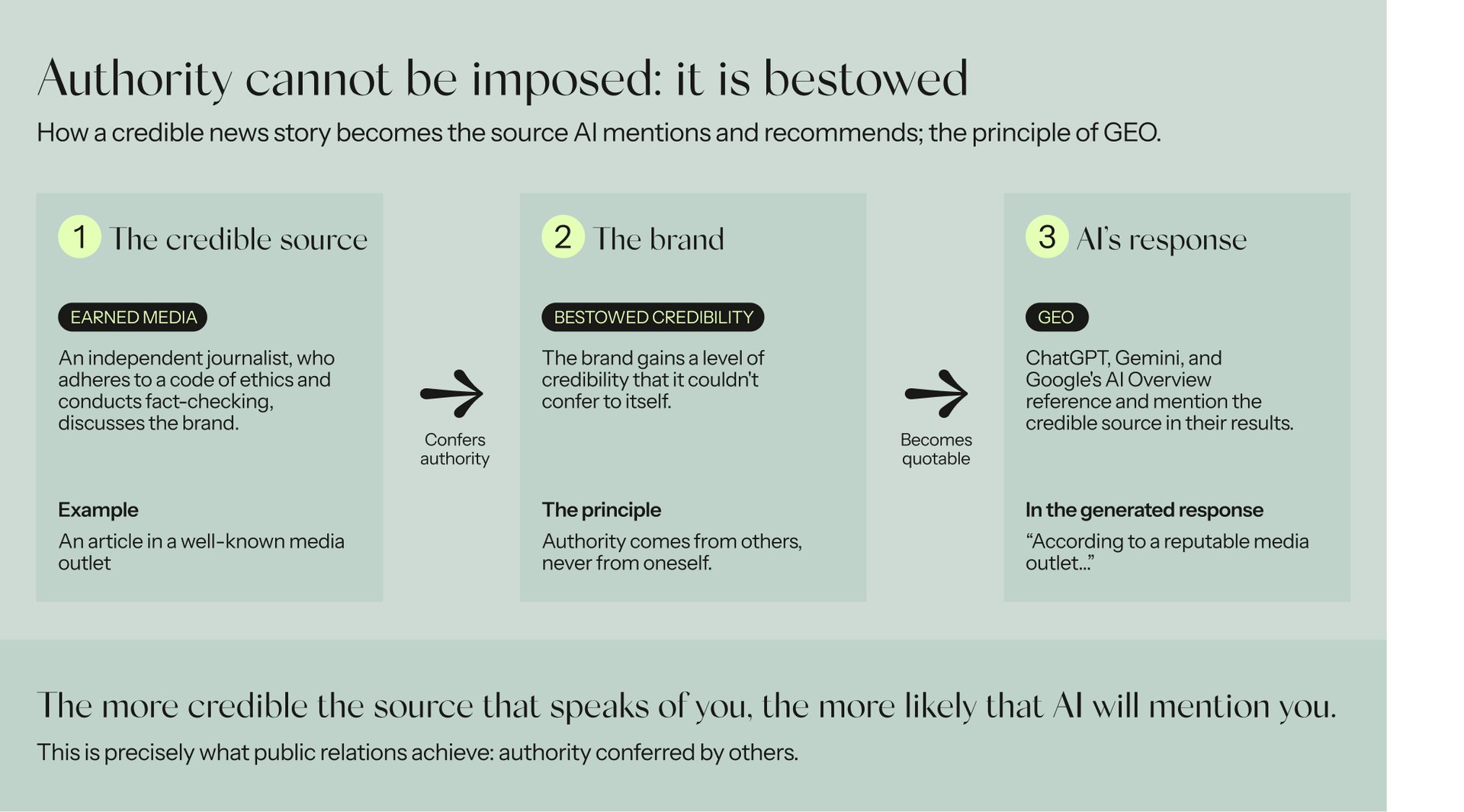
To understand this resurgence, we must first agree on one word: authority. In search engine terminology, “authority” refers to the degree of trust that a source inspires. This is not a reputation you can claim for yourself: this is a level of credibility that you earn from others. Content is considered authoritative when it is validated by independent, verifiable, recognized sources.
However, few sources embody this authority as clearly as journalism. A news article is written by an independent journalist who is bound by a code of ethics, subject to fact-checking, and accountable to the public. When a credible media outlet reports on an organization, it doesn't just mention it – some of the outlet’s own credibility shines upon it. This is exactly what generative models look for when they produce a response. Industry data also supports this view: a large majority of the sources cited by generative AI are reportedly from earned media rather than from paid advertising content.
A Quarter-Century of SEO: Two Areas of Expertise Feeding Into Each Other
Let's take a step back. For nearly 25 years, online visibility has largely hinged on a single factor: search engine optimization, or "SEO". From the late 1990s until very recently, being found meant appearing at the top of the list of links displayed by Google. Keywords, backlinks, technical structures: an entire sphere of work has been built around this mechanism, and it has proven its worth. SEO is a demanding field of expertise in its own right, and those who practice it rigorously can create real value.
During those years, it was sometimes thought that public relations had taken a back seat, with SEO doing the work. That was a misreading of how things work. What gave an inbound link its weight, if not the credibility of the site linking toward you? What fuelled a brand’s reputation, if not what the media said about it?
Both fields moved forward together: media coverage generated authoritative sources, and search engine optimization made them discoverable. Far from fading away, public relations were working hand in hand with digital marketing. It’s not "PR is back", but rather "PR was never gone."
What GEO Changes, and What It Doesn't Change
What changes with generative engine optimization, or “GEO”, is the very form of the response. We no longer submit a query in order to obtain a list of links: we ask a question and receive a summarized answer generated by ChatGPT, Gemini, or Perplexity. The act of clicking has largely disappeared, since nearly 6 out of 10 searches now end without a single visit to a website. The challenge, therefore, is no longer just about ranking highly: it’s about being the source that AI mentions, summarizes, and recommends.
And to be that source, two areas of expertise become inseparable. Digital marketing, with GEO, makes content that is clear, structured, measurable, and machine-readable - and therefore easy to draw from. Public relations, for its part, produces exactly what machines seek to validate: credibility conferred by third parties. GEO does not replace public relations, just as public relations do not replace GEO; the two are closely related. Today, visibility is achieved at their intersection.
Long Before the Internet
In fact, this approach predates the Web. Long before search engines existed - back when media coverage was measured by a newspaper clipping, a radio segment, or a news report - public relations professionals were already carrying out this mandate: getting a credible third party to talk about you.
Why did it matter so much? Because a mention in Canadian manufacturing or the Montreal Gazette, an interview on CBC Radio or a television report wasn't a paid advertisement: it was an outside perspective, filtered through a journalist. Knowing this, the public placed trust in the company that no advertisement could buy.
The Internet has not diminished this value in any way. If anything, it has amplified it. What used to be a fleeting impact, lasting only as long as the current issue of a magazine, is now permanent, searchable, mentionable, and increasingly consulted by artificial intelligence models. The scope has changed in scale. The goal, however, has remained the same.

Article du Journal de Montréal à l'occasion de l'inauguration de la nouvelle exposition du musée J. Armand Bombardier en 2009.
Positioning: The Goal That Has Never Changed
Let’s focus on corporate public relations, the kind that serves organizations, because this area also addresses several other needs. The goal of public relations hasn’t changed, and it can be summed up in one word: positioning. And the subjects to be positioned can vary. For example:
A brand or organization, as a market leader.
Leaders whose expertise sheds light on a societal issue. By speaking out on a topic that extends beyond the organization, a leader gains visibility and credibility, and their company benefits as a result.
A product or service that meets a real need. I’m thinking of DeepSight’s smart glasses, which track workers’ everyday movements in order to pass on their expertise to the next generation. I’m also thinking of everything that is designed and manufactured here in Quebec, at a time when buying local is no longer just a reflex but a conscious choice.
A cause or social issue, to rally public support and drive change, as we are doing with ALS.
Then as now, the goal remains the same: to ensure that an organization, a person, a product, or a cause occupies its rightful place in the public eye. But merit alone is not enough: one must also succeed in making it known. This is precisely where public relations come into play.
What the Age of AI Reminds Us Of
So yes, it’s great if the phrase “PR is back” draws attention to a field that some people have long believed to be on the decline. But as professionals, we can confidently say that public relations are not coming back from anywhere. They were already there before generative engines, before SEO, and even before the Web. And they have never worked in isolation: it is when working with digital marketing - SEO in the past, GEO today - that they reach their full potential. What the age of AI reminds us of is the value of what has always been at the core of public relations: a credible, independent, well-deserved voice.
Frequently Asked Questions
What is GEO?
GEO, which stands for “Generative Engine Optimization”, refers to the optimization of content for generative engines such as ChatGPT, Gemini, or Perplexity. Whereas SEO aimed to rank highly in a list of links, GEO aims to become the source that an AI mentions and summarizes in its response.
Why are we hearing that “PR is back”?
Because generative engines rely on credible sources, and earned media is among the most reliable. Public relations work - getting credible third parties to talk about you - thus becomes a key driver of visibility. That being said, public relations never went away; it’s just that they’re now back in the spotlight.
From an AI's perspective, what gives a source “authority”?
Authority is the trust that a source inspires; it is earned from others, it can never come from oneself. Content is considered authoritative when it is validated by independent, verifiable, and recognized sources. Journalism is the clearest example of this: an article, fact-checked by a credible media outlet, thus gains some of that outlet's credibility.
Has search engine optimization (SEO) become useless?
No. SEO remains a specialized field in its own right, as well as a demanding task. GEO does not replace SEO; it complements it. Digital marketing and public relations work hand in hand: one produces content that is clear and easy to find, while the other gives it the credibility that search engines look for.
Does optimizing for AI mean writing for a machine?
No, and that's a crucial distinction. The reason search engines mention earned media is that a journalist first saw it as a credible and substantial story. Writing for the algorithm, rather than for the reader, would undermine that credibility. Content must be structured to make it readable, but it is first and foremost written so that it is worth reading. A good story remains the best GEO strategy.
Where should one start in order to be picked up by AI?
By focusing on a proactive and consistent media strategy, rather than on one-off efforts. Through credible and regular communication, an organization builds its digital goodwill: a positive and lasting presence that audiences - and AI systems - eventually come to recognize.