Knowledge Sharing
Google Ad Grants for Nonprofits: How it Works and Who is Eligible
Google offers nonprofit organizations up to US$10,000 per month in advertising. Yet many nonprofits here are not taking advantage of the program because they assume they are not eligible. Here’s how Google Ad Grants works and why your organization may qualify.

What is Google Ad Grants?
Google Ad Grants is a program that provides non-profit organizations with free advertising on Google Search. In practical terms, when someone searches for something like "where to donate clothes in Quebec City" or "emergency food assistance," your organization can appear near the top of the search results, and you do not pay for the click.
Since launching the program in 2003, Google says it has provided more than US$10 billion in free advertising to over 115,000 organizations across 51 countries.
The grant provides up to US$10,000 per month in advertising credit, or approximately US$329 per day. The word "credit" does not mean that money is paid directly to the organization. The amount can only be used within Google Ads and on Google Search. It cannot be transferred to social media advertising or other types of display campaigns.
Another important detail: the credit does not roll over. Any amount that goes unused in a given month cannot be carried forward. The available balance resets at the beginning of each month.
Who is Eligible for Google Ad Grants in Canada?
In Canada, Google recognizes four types of eligible organizations: registered charities with the Canada Revenue Agency (CRA), tax-exempt, non-profit organizations, federally incorporated non-profit organizations, and provincially incorporated non-profit organizations. An organization incorporated under Part III of Quebec’s Companies Act falls within this framework.
A registered charity number is not required. Yet this remains one of the most common misconceptions about the program and one of the largest barriers to participation. Many organizations that are fully eligible rule themselves out because they believe they must first be registered as a charity.
Three categories remain ineligible: government entities, health care organizations, and educational institutions such as schools, CEGEPs, and universities. Their foundations, however, may qualify. For example, a hospital foundation may be eligible even if the hospital itself is not.
Eligibility is verified through Goodstack, Google’s validation partner. This is often the most time-consuming part of the application process. One useful tip is to gather your incorporation documents and registration information before getting started, and to make sure your website uses HTTPS, the secure version of a website address beginning with "https://".
Google Ad Grants is also available in France, where it is open to eligible associations and foundations. However, because eligibility criteria vary by country, organizations should consult Google’s dedicated eligibility information for France. The way the advertising credit works and the account management requirements are otherwise largely similar to those in Canada.
What Google Ad Grants Can Help You Achieve
Recruiting volunteers, filling seats at an event, promoting a service, and attracting new donors are four of the areas where the grant can provide the most value. They also have one important thing in common: the person you are reaching is already looking for something.
That is what makes Google different from social media. On social platforms, you are interrupting someone who was looking at something else. With Google, you reach people at the moment they are actively searching, whether they type "emergency food assistance" or "volunteering with seniors in Montreal" into Google Search, or look for nearby services on Google Maps. In both cases, the person has a clear intent, and your organization has an opportunity to respond to it.
This helps explain why Google Ad Grants can be particularly effective for recruitment and action-oriented campaigns rather than general awareness. Searches related to volunteering or event registration may not happen in huge volumes, but they are highly targeted, and there is often very little commercial competition for those searches. An organization looking for 20 volunteers does not necessarily need to be seen 20,000 times.
Google Ad Grants also makes it possible to track what happens after someone clicks on an ad. A donation, registration, completed form, or downloaded document can all be measured. For many organizations, this is the first time they are able to quantify what their communications efforts are actually producing.
That data often becomes valuable in reporting and grant applications, where demonstrating measurable results can ultimately be worth even more than the advertising credit itself.
Search and Performance Max: Two Types of Campaigns
A Google Ad Grants account can use two main types of campaigns, and many organizations benefit from combining them.
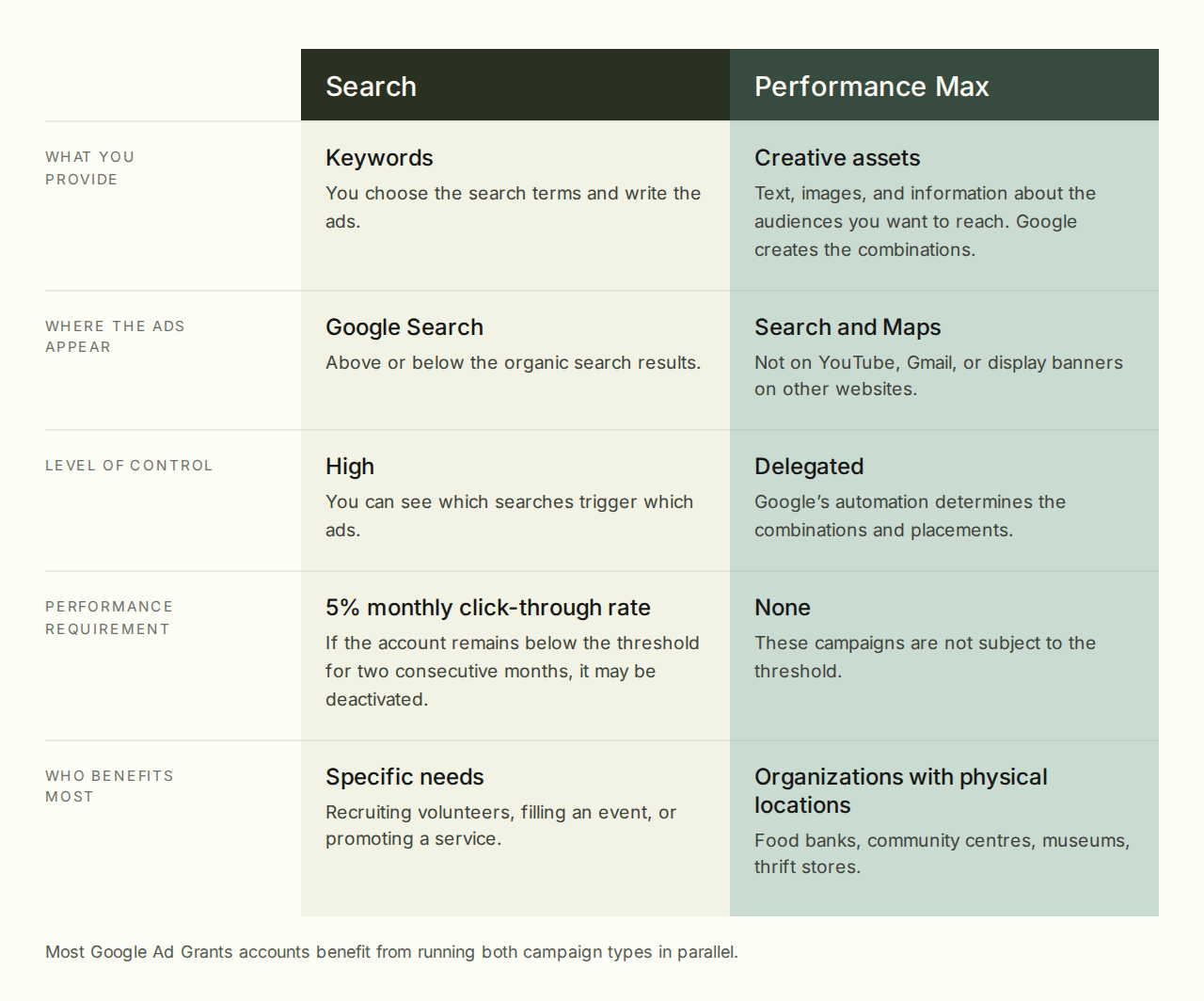
Search campaigns are the original format. They involve building a keyword list and writing text ads that can appear above or below organic search results. This format offers the greatest level of control because you can see exactly which searches trigger specific ads. Much of the work happens before launch, particularly when choosing the right keywords and creating the landing page users will reach after clicking the ad.
Performance Max campaigns were introduced more recently and offer a different approach. Instead of relying primarily on keywords, organizations provide Google with headlines, descriptions, images, and information about the types of people they want to reach. Google’s automation then determines how the campaign is delivered. Because of the requirements of the Ad Grants program, these ads remain limited to Google Search and Google Maps, they do not appear on YouTube, display banners on other websites, or Gmail. However, they are not subject to the same performance requirement discussed later, which removes an important source of pressure for organizations managing the account.
Performance Max also extends the program’s reach beyond the traditional Google search bar. Someone using Google Maps to find a nearby service is expressing just as much intent as someone typing a question into Google Search.
The inclusion of Google Maps is particularly valuable for organizations with a physical location, such as food banks, community centres, shelters, museums, and thrift stores. These are often the types of organizations that may have struggled to use their full advertising credit through Search campaigns alone.
The Rules You Need to Follow to Keep Your Google Ad Grants Account Active
Four requirements are behind most Google Ad Grants account suspensions:
At least 5% of people who see an ad must click on it. This is known as the click-through rate, or CTR, and it is calculated across the entire account. If the account falls below 5% for two consecutive months, it may be temporarily suspended.
Conversion tracking must be working. In other words, Google must be able to track actions such as donations, registrations and completed forms on your website.
Single-word keywords are generally not allowed. "Help" would not be accepted, while "food assistance Gatineau" would. There are a few exceptions, including your organization’s name.
The account must remain active and properly maintained. This includes using geographic targeting, adding additional links beneath ads, and maintaining an HTTPS website that does not contain paid advertising.
The program is free, but participation comes with conditions. Google monitors these requirements on an ongoing basis and may suspend accounts that do not comply. This is what often happens when an account is created and then left unattended.
The Limitations of Google Ad Grants
In the search results, Google Ad Grants ads appear below paid ads. For searches where businesses are actively bidding, your ad may appear in a lower position regardless of how well it is written.
The program is also limited to search-based advertising. It does not include video ads, display banners on other websites, or remarketing to people who have already visited your website. If you want to tell your story to an audience that is not already searching for your organization or services, you will need to use another channel.
However, one of the most common issues we identify during an account review has nothing to do with the grant itself: Google Ad Grants cannot fix a website that does not convert.
If visitors reach your website and leave immediately, the problem is happening after they discover the ad. In that case, the issue is often the landing page and whether it is designed to encourage the desired action. Sending more traffic to a page that does not perform well will only amplify the problem.
How deRabane Can Support Your Google Ad Grants Account
The deRabane agency works with organizations of all types and with budgets of all sizes. What remains consistent is the time we invest in understanding each organization’s needs and objectives before moving into development.
The process starts with conversations with the people who carry the organization’s mission every day: what the organization actually offers, how it describes those services, the audiences it wants to reach, the busiest times of year, and more.
The keywords that generate meaningful results come from this analysis, not simply from a keyword suggestion tool. This process also allows us to advise clients on where their budget and efforts are most likely to have the greatest impact, based on their specific objectives.
From there, the mandate generally unfolds in five stages, depending on the organization’s needs.
We set up the account with you. This includes eligibility verification, preparing the application, completing the Goodstack validation process and more. This is often the stage where organizations give up because the process can feel complex.
We define what success looks like. Recruiting volunteers, filling an event, increasing donations and other goals all require a clear destination. An account without specific objectives will eventually run without producing meaningful results.
We identify the right keywords and the right audiences. Some search terms attract attention without generating clicks, while others bring in fewer people but attract the right people. This is one of the most important parts of the mandate.
We set up tracking and launch the campaigns. Without conversion tracking, there is no reliable way to know whether the account is generating results or supporting the organization’s mission, and the account cannot move beyond the US$2 cost-per-click bidding limit.
We optimize and report on performance. Each month, you receive a clear report showing how many people saw your ads, how many clicked, and how many completed the desired action. This information can also be reused in accountability reports and funding applications.
All of this is integrated into the organization’s broader communications plan. Campaign periods should follow the organization’s calendar, including fundraising campaigns, seasonal recruitment periods, annual events and other key moments.
Every month without an active account represents up to US$10,000 in advertising credit that your organization is not using.
We can review your organization’s eligibility together and, if you already have an account, assess what results it is generating today.
Frequently Asked Questions
Is Google Ad Grants really free?
Yes. Google provides up to US$10,000 per month in advertising credit at no cost and without requiring any financial contribution from the organization.
No money is paid directly to the organization. The credit can only be used to run ads through Google. The main potential cost is the time required to manage and optimize the account.
Can a non-profit organization qualify without a registered charity number?
Yes. In Canada, Google recognizes four eligible organization types, including tax-exempt non-profits and provincially incorporated non-profit organizations.
A registered charity number is therefore not mandatory. Government entities, health care organizations and schools are not eligible, although their foundations may qualify.
How long does approval take?
Approval can take anywhere from a few days to a few weeks.
The most time-consuming step is usually the organization verification process completed through Goodstack, Google’s validation partner. Having your incorporation documents and registration information ready in advance can help speed up the process.
Why was my Google Ad Grants account suspended?
In many cases, an account is suspended because its click-through rate falls below 5% for two consecutive months or because conversion tracking is not functioning properly.
Other common causes include the use of single-word keywords and failing to properly define geographic targeting.
The suspension is usually temporary. Once the issues are corrected, you can request that the account be reinstated.
Can we use Google Ad Grants and paid Google advertising at the same time?
Yes, through two separate accounts.
In fact, this can be a useful structure. The grant account can support searches related to the organization’s name and broader informational searches, while a paid account can be used in areas where the US$2 cost-per-click bidding limit restricts reach.
Is Google Ad Grants available in France?
Yes. The program is available in 51 countries, including France, where it is open to eligible associations and foundations.
Eligibility requirements vary by country and should always be confirmed on Google’s page for the country concerned. However, the way the advertising credit works and the general account management requirements are broadly similar.
How much time does it take to manage a Google Ad Grants account each month?
For a stable, well-structured account, one to two hours per month may be enough.
You should expect to spend considerably more time during the first three months. This is when keyword lists are developed, conversion tracking is configured, and the campaigns that perform best begin to emerge.
Does Google Ad Grants really work?
It can, when the account is properly structured, actively managed and regularly optimized.
When an account is created and then left unattended, results are much less likely to follow, and this happens often. The difference is not the size of the grant, since eligible organizations receive access to the same advertising credit. The difference is how consistently and strategically the account is managed.