Knowledge Sharing
How to Increase Your Chances of Being Cited by AI
Did you know that LinkedIn has become one of the most frequently cited sources in AI-generated responses? In the age of artificial intelligence, publishing regularly on the platform can be a valuable strategy. In this article, we will explore why AI systems tend to favour LinkedIn, how to structure your posts to improve their chances of being cited, and the limitations of this approach.
What Does It Mean to Be Cited by AI?
When someone asks a question using ChatGPT, Perplexity, Copilot, Claude, or Google’s AI Overview, the tool no longer simply provides a list of links. Instead, the AI generates a response using sources it considers reliable and may identify some of them at the end of its summary. Appearing among those sources is what it means to be “cited” by AI.
Optimizing content for this new search behaviour even has a name: GEO, or Generative Engine Optimization. While SEO (Search Engine Optimization) focuses on ranking well in search results, GEO focuses on having your content included directly in an AI-generated response. The difference is significant. In traditional search results page, there may be ten or more opportunities to appear. In an AI-generated response, only two or three sources may be cited.
LinkedIn Is the Second Most-Cited Source by AI
According to a 2026 Semrush study based on 325,000 queries submitted to ChatGPT Search, Perplexity, and Google AI Mode, LinkedIn now ranks second among the sources most frequently cited by AI systems, ahead of Wikipedia, YouTube, and major news outlets.
The study also found very high semantic similarity scores. In other words, AI systems do more than simply cite LinkedIn content: their responses often closely reflect the wording and ideas used in the original posts. This means that what you publish on LinkedIn can directly influence how AI systems present a brand, service, or topic.
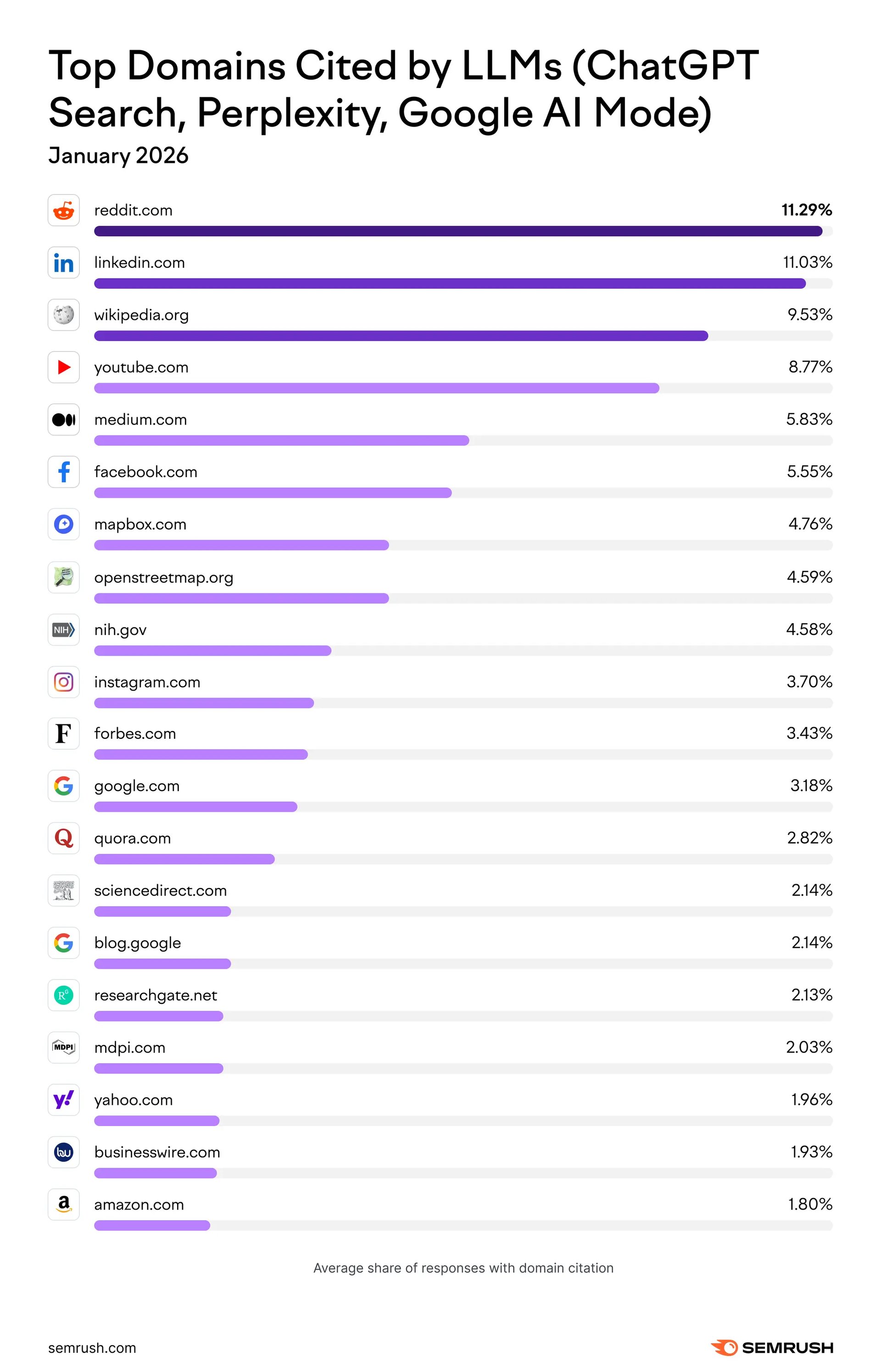
Average Percentage of Responses Mentioning a Domain
Why Are AI Systems Turning to LinkedIn?
First and foremost, it comes down to trust. LinkedIn content is professional, contextualized, and tied to identifiable individuals and companies, exactly the kind of information AI systems rely on when building credible responses.
LinkedIn itself has reinforced this point through its VP of Marketing, Davang Shah, whose recommendations were highlighted by Social Media Today: content that demonstrates expertise, provides context, and offers useful information is more likely to be referenced by AI systems.
Why Do These Citations Matter?
Being cited by AI can extend your authority far beyond your immediate network. Your content is no longer seen only by your followers; it can become part of an AI-generated response presented to a much broader audience that may not yet know you.
Decision-makers are also increasingly using AI tools to build an initial shortlist of potential suppliers or experts. Being mentioned by an AI assistant can therefore place your brand within the consideration set at the very moment someone is searching for a solution, often before the first conversation even takes place.
That is where visibility can become a tangible business advantage.
How Should You Structure Your Content to Increase Your Chances of Being Cited?
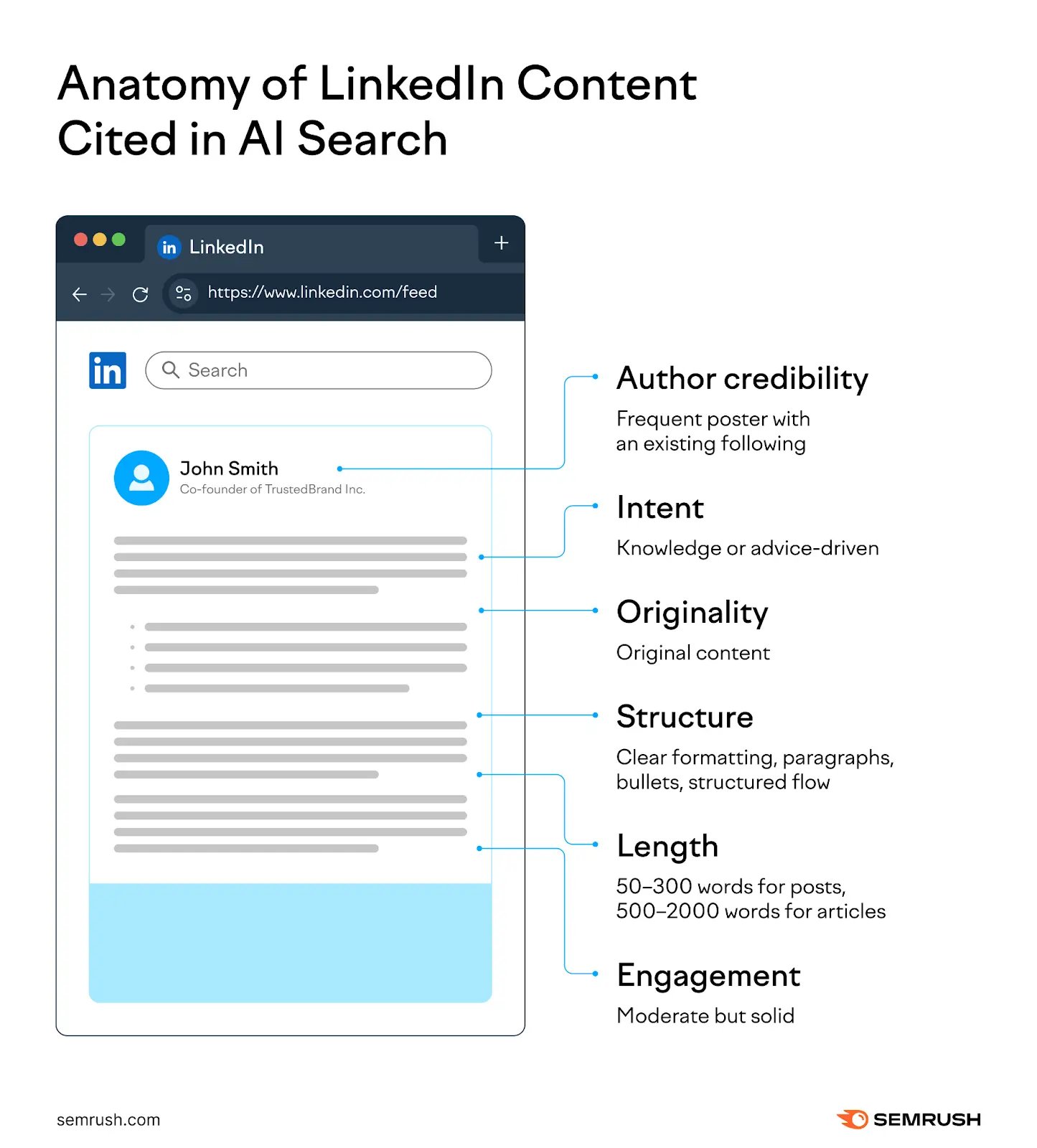
The Semrush study also examined the types of content most likely to be cited by AI systems. Here are three key areas to focus on, from the most technical to the most strategic.
1. Your Post's Opening LinkedIn Line Becomes Part of Your URL
Here is a detail many content creators overlook: LinkedIn generates a post’s URL based on its first line, and that URL is fixed once the post is published. Even if you later edit the post, the URL remains unchanged.
The simple takeaway: your most important keywords should appear as early as possible. Opening with a hashtag or a vague phrase can create a generic URL that weakens the relevance of your content, while starting with the actual topic creates a cleaner, more descriptive address that algorithms can interpret more easily.
The same principle applies to attachments. The name of an attached PDF may take precedence over the first line of your post. Use clear, descriptive file names rather than internal codes.
2. Structure Your Content for AI, Not Just Your Audience
AI systems do not process content the same way people do. They break information into sections, isolate key elements, and reassemble them into new responses. That means structured content is easier for AI to interpret and reuse. According to analyses compiled by Influence Start, nearly all LinkedIn posts cited by AI contain lists, while many also include specific figures or data points.
3. Habits to Adopt Now
Use lists whenever the content allows for it. Bullet points and numbered lists make key ideas easier to identify and reuse.
Ask a question, then answer it. A subheading written as a question followed by a concise two-sentence answer creates a clear, reusable block of information. Think of your content as you would an FAQ.
Name relevant entities. Companies, technologies, recognized standards, and other specific references provide valuable context and help AI systems understand where your expertise fits.
Prioritize educational value. Content that explains how something works is more likely to be cited than content focused primarily on promoting a product or service.
4. Build Authority Over Time
Being cited is rarely the result of a single post. It comes from building a consistent presence over time. LinkedIn recommends publishing two to three times per week and emphasizes that consistency matters more than short bursts of activity followed by periods of silence.
Engagement also plays an important role. According to Davang Shah, engagement signals gathered during the first 24 hours can influence how widely a post is distributed. High-quality comments, those that add perspective or move the conversation forward, can send positive signals both to LinkedIn’s algorithm and to AI retrieval systems. Respond to comments promptly and encourage discussion by ending your posts with a relevant question.
One final point: simple reshares are cited far less frequently. Original content is what builds authority.
Invest in LinkedIn? Yes, But Not Exclusively
LinkedIn can help make your content more likely to be cited, but the platform does not belong to you. A post can disappear from the feed within 48 hours, reshares are rarely cited, and you have no control over the algorithm or the lifespan of your content.
The posts that generate the most likes and comments are not necessarily the ones most likely to be cited by AI. Why? Because AI models prioritize content that is most relevant to the question being asked, not simply the content that is most popular. In other words, they do not follow the same popularity-based logic as traditional search engines.
To conclude, my recommendation for increasing your chances of being cited in AI-generated responses is simple: diversify your communication channels.
LinkedIn is an excellent platform, but it should be part of a broader content strategy. You should also create content on channels you own, such as your website or blog, and invest in earned media, including media coverage generated through public relations and press outreach.
Where Should You Start?
We look at what you are already publishing, what AI platforms are currently saying about you, and what may be missing for your content to appear in their responses.
Frequently Asked Questions
Why is LinkedIn cited so often by AI platforms?
According to Semrush’s 2026 study of 325,000 analyzed queries, LinkedIn ranks second among the content sources most frequently cited by AI systems, ahead of Wikipedia, YouTube, and traditional media.
AI platforms tend to favor LinkedIn because it brings together contextualized professional information linked to identifiable people and verifiable companies, making it a strong source for building credible responses. LinkedIn Vice President of Marketing Davang Shah has also indicated that content offering greater expertise and context is more likely to be referenced.
What types of LinkedIn posts are rarely cited by AI?
Posts that offer little or no original value are unlikely to be cited. Simple shares or reshares tend to receive limited visibility, as do posts that primarily promote an offer rather than explain how something works.
The posts that receive the most likes are not necessarily the ones AI systems cite most often either. AI models tend to prioritize content that is relevant to the question being asked rather than content that is simply the most popular.
Which AI platforms cite content published on LinkedIn?
Major generative AI platforms that build responses using external sources include ChatGPT, Perplexity, Microsoft Copilot, Claude, and Google AI.
Each platform generates responses using sources it considers credible and relevant. When content appears as a supporting source in those responses, it is considered to have been “cited.”
Because different AI platforms evaluate and extract information in different ways, a strong content strategy should focus on creating well-structured, authoritative content that can be easily understood and referenced across multiple models rather than optimizing for a single AI platform.
How often should you post on LinkedIn to increase your chances of being cited by AI?
LinkedIn recommends posting two to three times per week. However, consistency matters more than volume. A steady publishing rhythm maintained over time generally performs better than a few highly active weeks followed by long periods of inactivity.
Engagement during the first 24 hours can also influence a post’s distribution, which makes responding promptly to comments particularly valuable.
Is publishing on LinkedIn enough to remain visible to AI over the long term?
No. LinkedIn should be one part of a broader content strategy because you do not own the platform and cannot control its algorithm or how long your content remains visible.
A diversified approach is recommended, combining LinkedIn with content published on your own channels, such as your website or blog, as well as earned media opportunities such as press coverage and public relations.